Content
One battery, four value streams: why now is the best time to plan a C&I battery
It is a windy winter evening, with no sun and negative prices in the market. The battery on site could charge and earn money. Instead it sits idle. A single kilowatt-hour drawn from the grid and fed back in would cost the operator their subsidy for the PV system. Because of this, tens of thousands of C&I batteries in Germany operate below their real capability. From 1 October 2026, that changes for the first time.
MiSpeL in brief: value streams, rules and timeline
The regulation of the Federal Network Agency on the market integration of storage and charging points (MiSpeL), unlocks the full potential of C&I batteries. In the future, batteries can mix green and grey electricity without forfeiting their subsidies. This opens up four value streams in parallel, provided an optimiser can weigh these against each other per quarter-hour:
Feed-in optimisation – storing excess solar generated at midday and feeding it in during the high-value evening hours, with the subsidy (Marktprämie) retained.
Consumption optimisation – the battery covers site demand with excess generation from the PV system and charges from the grid when electricity is cheap, lowering procurement costs for the site.
Arbitrage – the battery charges at low prices and sells high. Since arbitrage can be exempted from grid fees and levies, trading becomes worthwhile with smaller price spreads in the market.
Peak shaving – the battery discharges into the highest grid draw peaks of the year. In the C&I segment these determine the capacity charge and thus a substantial share of grid fees.
To enable this, the regulation introduces a new ruleset: the “Abgrenzungsoption”. It is open to installations of any size and allocates electricity volumes based on quarter-hour meter readings and set allocation rules.
The rules become usable in principle from 1 October 2026, but are mandatory only a year later. During the transition year, the Abgrenzungsoption can be applied only with the consent of the grid and metering point operators. Implementation becomes mandatory across all network areas from 1 October 2027.
MiSpeL allows green and grey electricity to be separated within the same battery
At present an either/or applies: as soon as a single kilowatt-hour of grid electricity is charged into the battery, the subsidy is forfeited. This exclusivity principle severely limits the economics and flexibility of co-located systems. Returning to the windy winter evening: the battery could absorb surplus electricity from the grid, but it is not permitted to do so without losing its subsidies. The battery remains idle and empty.
MiSpeL addresses precisely this situation. It introduces rules that separate green and grey volumes for a mixed-use battery and allocates the volumes via meter readings and rules. Both benefits can then be used in parallel: the Marktprämie for green electricity fed in directly or via the battery, and the exemption from levies and grid fees for arbitrage.
MiSpeL timeline: usable in principle from October 2026, mandatory only from October 2027
The Federal Network Agency was unable to meet its set statutory deadline of 30 June 2026. On 5 August 2026 it published its working version of the MiSpeL regulation, explicitly without a further consultation round. The regulation entering into force on 1 October 2026 should therefore largely or entirely correspond with the working version.
1 October 2026 – Publication of the final regulation and planned entry into force; the Federal Network Agency has announced an explanatory workshop for 2 October 2026.
until 30 September 2027 – Transition year: the MiSpeL rules apply only where the relevant grid and metering point operators consent.
from 1 October 2027 – Mandatory application begins: all grid and metering point operators must implement MiSpeL rules.
Green or grey is determined by meter readings and allocation rules
The “Abgrenzungsoption” determines subsidy-eligible green electricity and grid fee and levy exempt grey electricity volumes through allocation rules, based on quarter-hourly meter readings. Four key points form the foundation of the rules:
Allocation per quarter-hour. The asset behaviour is metered and the respective volumes are computed for each individual quarter-hour. The battery is no longer permanently green or grey, but can adapt its role to market conditions, generation and site load.
“Gewillkürte Vorrangregel” for batteries. Where a battery operates simultaneously with a renewable generation asset generation, its charging or discharging is allocated to the grid first. This makes it possible to allocate volumes between green and grey even when generation, consumption and battery operation fall within the same quarter-hour.
Monthly netting period. Grid draw and exported grey electricity can be netted against each other, so that levies and grid fees fall only on the balance, that is, on electricity that was actually finally consumed from the grid. This lowers the necessary price spreads for storage cycles and makes trading worthwhile in more quarter-hours. The latest working draft shortens this netting window from annual to monthly. This is more than a formality: under the annual model, every volume charged from the grid in winter diluted the green share and reduced the market premium on summer feed-in. Arbitrage and feed-in optimisation worked against each other. Now the monthly approach separates the two cleanly.
No double privileges. A given volume of electricity can be privileged only once: either through the Marktprämie for green electricity fed into the grid, or through the netting of levies and grid fees for grey electricity.
The following example illustrates the logic of the new rules for a single, representative quarter-hour.
Figure 1: Example visualisation of the "Abgrenzungsoption” rules
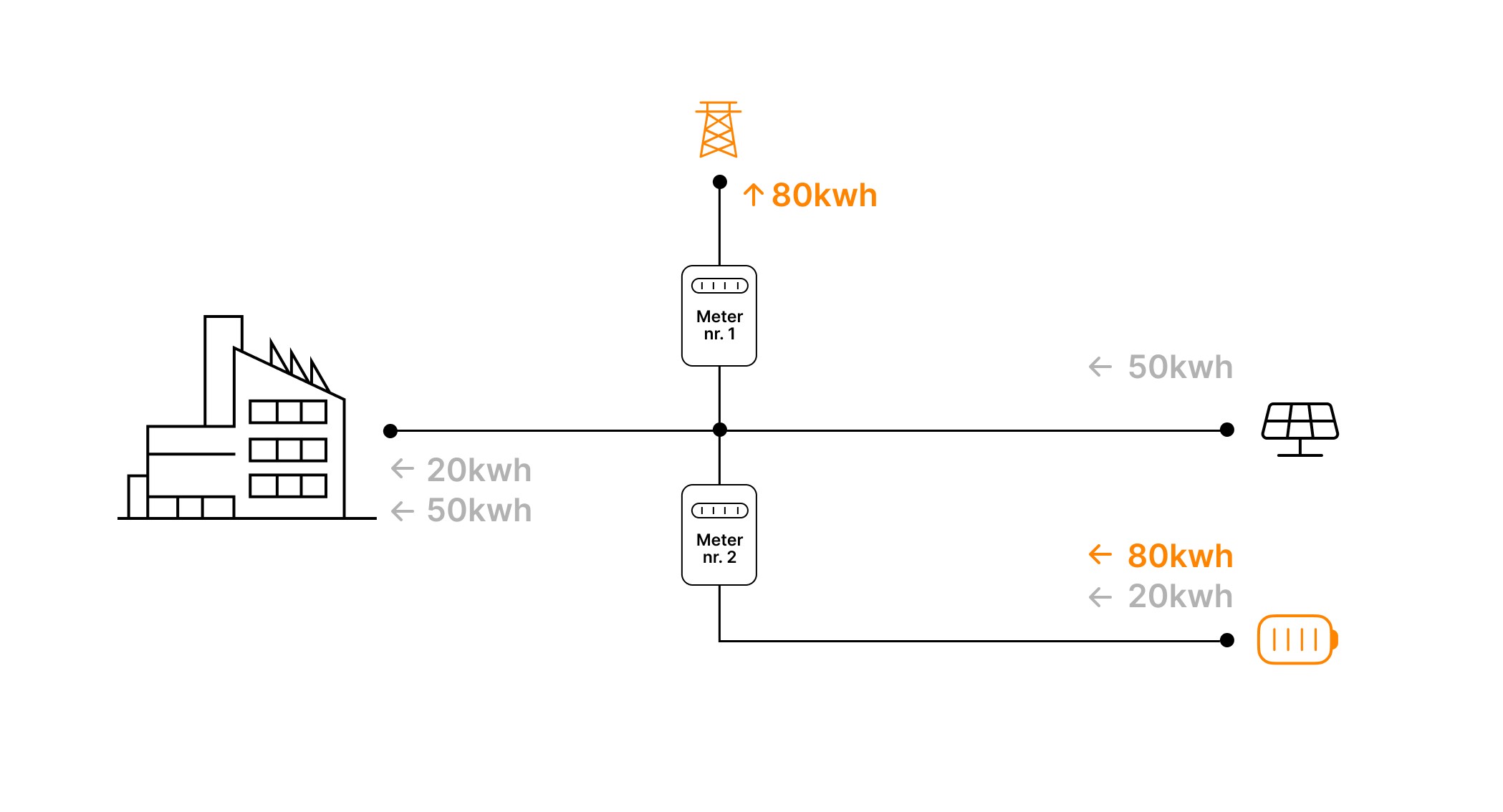
In a given quarter-hour, both the PV system and the battery are exporting: the battery discharges 100 kWh, the PV system generates 50 kWh, and 70 kWh are consumed on site. This leaves 80 kWh arriving at the grid connection point. Under the MiSpeL rules, these 80 kWh count as having originated primarily from the battery. They can then be netted against grid draw, reducing the levy and grid fee bill for the site.
Four value streams from one asset: lower consumption costs and earning additional revenues through exports
Until now, batteries have been restricted in terms of their value creation, irrespective of what would have made most sense in any given quarter-hour. In the future the same battery can affect both sides of the electricity bill: lowering consumption costs and earnings revenues from trading. Which value stream takes priority is determined anew in every quarter-hour. Four can be optimised in parallel.
Feed-in optimisation. Surplus midday generation is stored and feed-in is shifted into the higher value evening hours. The Marktprämie subsidy is retained for these volumes, even if the battery has charged from the grid in other quarter-hours.
Consumption optimisation. Excess solar generation is stored or the battery charges from the grid at negative prices to cover site-demand in expensive quarter hours in the early morning or evening. In addition, new ancillary services become accessible: some products require the battery to be able to draw from the grid. This was precisely what could not be reconciled with the subsidy entitlement until now.
Arbitrage. The battery charges at low or negative prices and sells high. Since stored volumes can be exempted from levies and grid fees, the price spread a storage cycle must clear is reduced. Trading therefore becomes worthwhile in additional quarter hours, and revenues for the asset operator increase.
Peak shaving. In the C&I sector, the annual peak grid draw determines the capacity charge for the site, which accounts for a substantial share of grid fees. The battery can reduce precisely these peaks by discharging to lower the grid draw. In future this will be possible either with green electricity generated on site or grey electricity charged from the grid.
The battery can finally access its full potential. The challenge, however, lies in the execution: in every quarter-hour, the PV system, the battery and the site load must be optimised jointly and a decision taken as to which value stream is prioritised.
Now is the right time to plan a C&I battery
At Flexa we already market 60,000 distributed assets in our virtual power plant, in quarter-hourly increments and across all relevant markets. Our experience in the residential segment enables us to accommodate every asset size, from 50 kW to 3 MW. For sites with their own consumption, we have long optimised both sides of the electricity bill together: consumption and feed-in. We are now bringing this aggregation and trading capability to C&I projects, with larger assets but the same expertise.
Planning or operating a C&I site with PV and storage? Get in touch and we will show you what is possible at your sites.
[ In the news ]